
Your customers aren’t searching the way you think they are. And that’s a problem.
Every day new acronyms keep coming at you — SEO, AEO, GEO — and if you’re an SME or solopreneur, getting your head around it all can prove challenging. So here, I break down the acronyms and give you good reason to take notice.
Because not taking notice? That’s a mistake that could make you disappear from search entirely, putting your business at risk.
Let’s start with the ‘Old Skool’, SEO.
(If you prefer, you can listen to an AI NotebookLM-generated podcast based on this blog post. It’s pretty much on the money.)
Search Engine Optimisation (SEO)
Keywords, links, meta descriptions and site speed, you’re probably familiar with it and have spent months of your life implementing it or paid a small fortune getting someone else to do so.
It’s still very much a player in the battle for visibility, but here are some stats for you to get your head around:
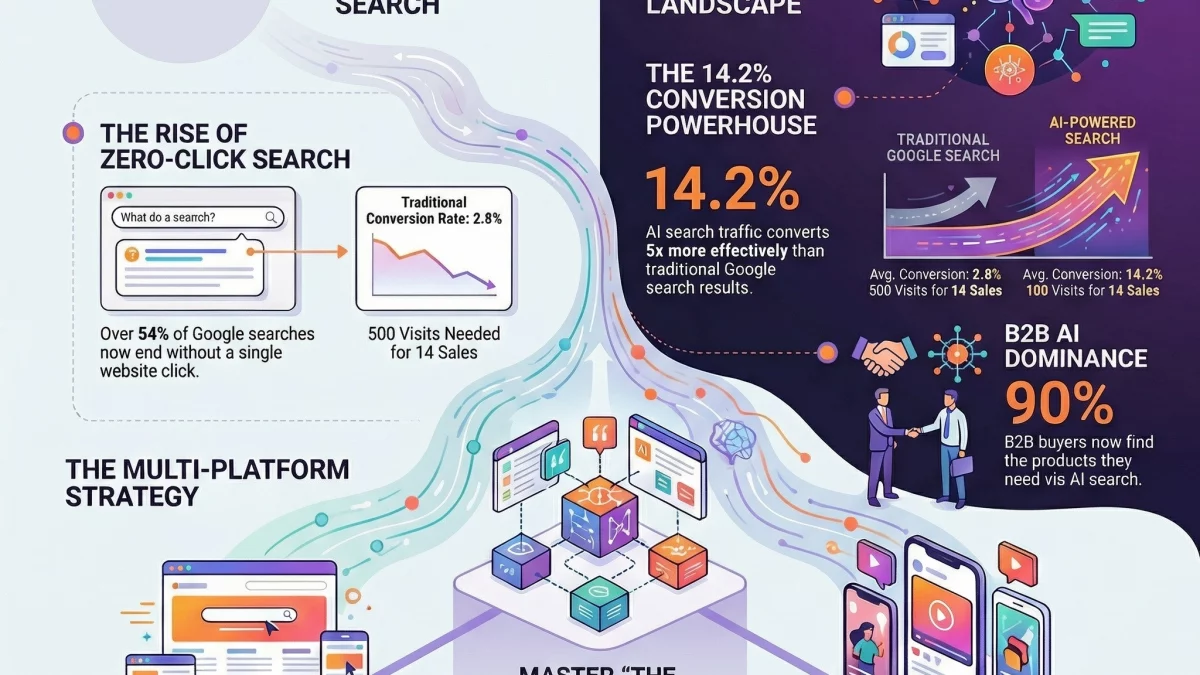
- In the UK and broadly worldwide, 54.4% of Google searches result in zero clicks. AI overviews simply give the information to the searcher, and off they go on their merry way. No more scrolling down looking at those hard earned search results.
- Position 1 won’t save you according to Ahrefs whose report concluded that most searches that showed an AI Overview, saw 34.5% drop in clicks.
- Since the advent of AI, organic and paid CTR has dropped even when an AI Overview isn’t shown according to Dataslayer.
Although many fellow Brits are still using Google, 83% of all searches are still carried out using the search engine, it is clear AI search is significant.
With this in mind, how do I make my business visible on AI search.
Answer Engine Optimisation (AEO)
AEO is where you optimise a page to make it easy for the AI to find information and present it back to the user. Say you sell shoes, and someone asks, “What is the best shop in Norwich for formal shoes”, you want the AI to answer the question, citing your brand in the process.
And here’s the brutal truth: Increasingly, you need to appear in the AI’s answer to make sales. Nobody, or at least very few, are looking at search engine result pages anymore when looking to buy.
Generative Engine Optimisation (GEO)
This takes AEO and takes it a step further. This is where a page is optimised not just to provide answers but to allow AI systems to easily parse, cite, and recommend it to potential customers and clients.
Arguably, this is where the money is, as studies are confirming that significant ROI can be had. According to various agencies in the UK, and Superprompt average AI search traffic converts anywhere between 1.2x – 4.1x higher than ‘Old School’ search.
It makes sense when you think about it. If you can get the AI to sell what you’re selling, then you’re moving your client and customer down the sales funnel to the sweet spot.
The Psychology of Your Customer
Customers who have found you on AI search that go on to visit your site, do so to confirm that the AI wasn’t hallucinating and what you sell is exactly what they want. Hence, the higher conversion rate.
AI Search vs. Google Search
Although Google smashes AI search in Britain, with 83% of us searching on Google, AI is rapidly catching up. 48% have dived into AI to find information they need, with many using it to shortcut the research process when in the mood to spend money.
Going by the stats we’ve seen earlier, 100 visits from AI provides 14 sales, while 500 visits from Google generates the same amount of sales. At least on average.
And as a freebie for you, according to 6sense, over 90% of B2B buyers now find what they need via AI search. Wow!
So What Gives?
It’s clear that ‘Old Skool’ search isn’t dead, but it is losing ground. Some speculate that in under five years, it will almost be replaced by AI search completely. Given their interdependence, AI’s use search APIs to find information, and this no doubt includes Big G. It is hard to imagine a world where ‘Old Skool’ search doesn’t play a part.
It’s clear, however, that AI search is to be optimised for. So how is that accomplished?
The Citation Economy
AIs like to promote ‘trusted’ content when giving a citation/recommendation. One aspect of the AI battleground is how quickly it can deliver a result, and the faster it can find what it needs from your content, the more likely it is to cite your customer, who hopefully clicks through and buys.
Right now, according to various marketing agencies, being cited in a top ten list, catches the attention of an AI crawler. Some also cite being visible on Reddit, although I did see a YouTube video from a leading marketer which stated otherwise. Apparently, Reddit doesn’t carry the same weight in the eyes of AI than it used to. So proceed with caution.
And Let’s Not Forget Social Search
The thing I don’t like about social search is that it doesn’t have an acronym, and so it didn’t fit neatly into the title of this blog. What I love about social search is that it presents good business opportunities.
And although this is arguably dominated by Gen Z, these guys are your future customers and shouldn’t be left out of your marketing plans if you want longevity and not become one of the doomed 60% of British businesses that fail within five years of opening.
For more information on branding and how it will help your business live, thrive and survive, see my branding services.
Fun Facts About TikTok
In the UK, 71% of platform users are Generation Z, i.e. born between 1997 and 2012, according to various marketing agencies. A sobering thought, however, is that Gen X and Boomers are taking to the platform, making up 1 in 6 of its user base.
More fun facts: 77% of Generation Z users use the platform for product discovery.
The bottom line is that social selling is huge, so your business should be visible here, too. It’s just how it is.
This is All Well and Good but how can my Business Become Omnipresent?
It’s clear that you have to market for SEO, AEO, GEO, and social media. This takes time, money, or both. Let’s work through some options.
Option 1: Hire an agency for £2K-5K per month
Agencies have the resources but they come with hefty price tags. Given the concept of AI search and how fresh it is, their focus may be on ‘Old School’ SEO rather than GEO. Also, for most business owners, it would be very hard to tell if they had an AI search strategy until six months down the line, and they’re not receiving visits from Chat GPT. (Other AIs are available).
I would proceed with caution before hiring an agency to become omnipresent. At the very least, I would put together a ton of questions before signing on the dotted line and parting with cash.
Option 2: DIY it yourself
You read some blog posts. Watch YouTube tutorials. Try to keep up with algorithm changes across Google, ChatGPT, Instagram, and TikTok.
What happens: You implement 10% of what you need, inconsistently, whilst trying to actually run your business. It’s a cruel world.
Option 3: Ignore it and hope for the best
Honestly, my friend, you need to ‘do one’. This isn’t an option, it is business suicide.
“My business has always relied on word-of-mouth.”
What happens: Your competitors who DO optimise for AI and social search steal your customers. Slowly at first. Then suddenly. Then you’re insolvent.
The Better Approach: Multi-Platform Visibility Strategy
Here’s what actually works in 2026:
For ‘Old Skool Search’ (SEO)
You still need this. 83% of Brits still use search engines monthly. Don’t abandon SEO. Just stop treating it like it’s the only game.
Quick wins:
– Ensure your Google Business Profile is complete and active
– Get legitimate reviews (Google still weighs these heavily)
– Maintain technical SEO basics (fast site, mobile-friendly, secure)
– Create high-quality content that answers specific questions
– Build genuine backlinks from relevant sources
Time investment: 2-3 hours per week minimum.
For AI Search (AEO/GEO)
This is where the conversion quality lives. AI Search traffic converts at 14.2% compared to Google’s 2.8%.
What to do:
– Structure content with clear, direct answers to common questions
– Use schema markup religiously (Product, FAQ, HowTo, Organisation)
– Create comprehensive, authoritative content that AI systems want to cite
– Include data, statistics, and concrete examples
– Build citations and brand mentions across the web
– Test your visibility: Search for your products/services in ChatGPT and Claude
Time investment: 3-4 hours per week to do it properly.
For Acronym Free Social Search
This is where your future customers are. 76% of users have discovered brands and products through social media.
What to do:
– Create short-form video content showing your products/services in action
– Use platform-specific optimisation (hashtags, keywords in captions, location tags)
– Post consistently (3-5x per week minimum)
– Engage authentically with your audience
– Showcase real customer results and behind-the-scenes content
– If you have the cash, consider the paid influencer route. Many book publishers have done this and become millionaires as a result.
Time investment: 4-5 hours per week for quality content.
“But I Don’t Have 10 Hours a Week for This?”
Exactly.
That’s the problem most small businesses and solopreneurs face. You need visibility across three different search ecosystems, but you’re already drowning in content creation.
You have three options:
1. Use AI to Scale Content Creation
Learn to use tools like Claude properly. Not “write me a blog post about X” and get instantly forgettable copy. Strategic AI implementation that maintains your brand voice whilst cutting production time from 3 hours to 30 minutes.
That’s what I specialise in. Brand-first AI systems that sound like you, not like everyone else using the same prompts.
2. Prioritise Ruthlessly
Can’t do everything? Focus on where your customers actually are.
- B2B service business? LinkedIn + AI search.
- E-commerce selling to Gen Z? TikTok + Instagram.
- Local service business? Google Business Profile + social proof.
3. Get Strategic Help
Not a £5K agency retainer. Strategic implementation that teaches you the system so you’re not dependent forever.
(That’s also what I do. But you probably guessed that.)
The Uncomfortable Truth
Most businesses will ignore this until it’s too late.
They’ll keep optimising exclusively for Google whilst their competitors build AI search visibility. They’ll dismiss TikTok as “just for kids” whilst Gen Z grows up and starts spending serious money.
Then one day they’ll wonder why their phone stopped ringing.
Search isn’t dead. It just evolved into three different beasts, and you need to feed all of them.
The businesses that adapt now have a 12-24 month head start whilst everyone else is still figuring out what GEO means.
Your choice: Lead the change or get left behind.
Want to Actually Do Something About This?
If you’re reading this thinking “right, I need to sort this out but I haven’t got a clue where to start,” I can help.
I specialise in brand-first AI implementation that gives you visibility across traditional search, AI search, and social search—without losing your authentic voice or spending 20 hours a week on content.
Not generic AI training. Not copy-paste prompts. Your system, built around your brand voice, that actually works.
Book a discovery call now and make moves into achieving the marketing holy grail of achieving omnipresence for your business.
Or keep doing what you’re doing. Your competitors will thank you for it.
Frequently Asked Questions
Do I need to optimise for all three — SEO, AEO, and social search?
It depends on where your customers actually are. B2B service businesses should prioritise LinkedIn and AI search. E-commerce targeting Gen Z? Focus on TikTok, Instagram, and social search. Local service businesses need Google Business Profile and social proof. Start with one or two channels, do them properly, then expand. Trying to do everything badly is worse than doing one thing well.
How long does it take to see results from AEO and GEO?
AI search visibility can happen faster than traditional SEO. With proper optimisation, you can start appearing in AI citations within 2-4 weeks. Traditional SEO typically takes 3-6 months. The key is creating comprehensive, authoritative content that AI systems want to reference. Schema markup and structured data help significantly.
Will AI search replace Google completely?
Unlikely in the next 5 years, but the balance is shifting. Google still handles 83% of UK searches, but AI search is growing rapidly — especially among younger demographics. The smart approach is to optimise for both. Traditional search isn’t dead, but ignoring AI search means missing out on higher-converting traffic.
Can I do this myself, or do I need to hire someone?
You can absolutely do this yourself if you have the time. The challenge is that it requires 8-10 hours per week minimum to do it properly across all channels. Most small business owners struggle to find that time whilst running their business. The alternative is strategic implementation — someone sets up your system, teaches you how to use it, and you maintain it yourself in 2-3 hours per week. That’s the approach I take with clients.
My business isn’t tech-focused. Does this still apply to me?
Absolutely. Whether you’re a plumber, solicitor, café owner, or consultant, your customers are searching for you online. If you’re not visible where they’re looking, they’ll find your competitors instead. This isn’t about being “tech-focused” — it’s about being findable. Every business needs visibility, regardless of industry.