
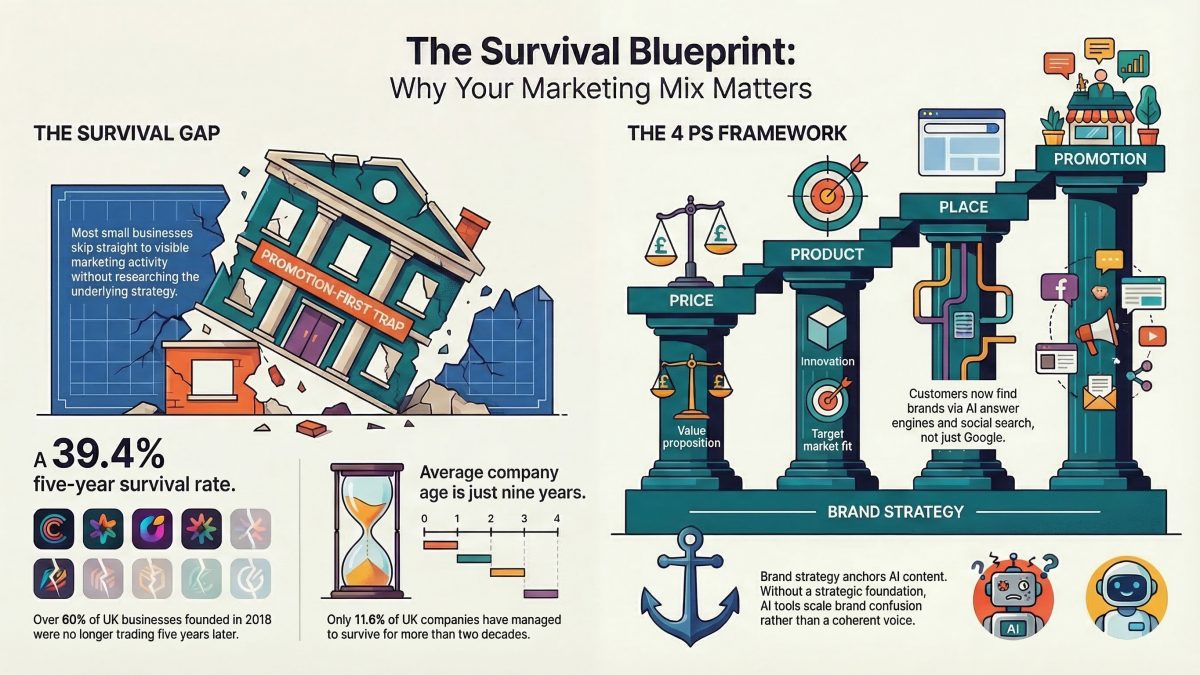
The marketing mix is a brand strategy framework built around four core areas: Product, Price, Place, and Promotion. Getting all four right is one of the most reliable predictors of long-term business survival.
The data makes the stakes clear. According to ONS data, businesses founded in 2018 had a five-year survival rate of just 39.4%. More than six in ten businesses launched that year were no longer trading five years later. The average age of UK companies today is just nine years, and only 11.6% have survived more than two decades.
Those aren’t abstract statistics. They represent real businesses, real owners, and real decisions that either held a business together or let it fall apart. And one of the most consistent factors separating the survivors from the closures is brand strategy: specifically, whether a business had a clear, researched answer to all four parts of the marketing mix before it started scaling.
Most don’t. And that’s where the problem starts.
If you prefer, you can listen to this NotebookLM generated audio version of this post. It’s pretty accurate in my view.
What Is the Marketing Mix?
The marketing mix is a framework for thinking about every dimension of how your business goes to market. Developed in the 1960s and still one of the most practical tools available to small business owners, it breaks your go-to-market approach into four distinct areas, each of which needs to work both independently and together.
Product covers the function of your product or service, the packaging, the people involved in delivering it, and the quality aligned with your target segment’s needs and wants. Not just what you sell. Whether what you sell actually fits the people you’re trying to serve.
Price covers perceived value, margin controls, and competitor pricing, all aligned with your target segment’s needs and wants. Price is never just a number. It signals quality, positions you in the market, and shapes the expectations customers arrive with before they’ve spoken to you.
Place covers the online or offline environment where you sell or distribute your product or service, aligned with customer needs. This is where your customers actually find you and buy from you: a physical location, your website, an online marketplace, or increasingly an AI search result.
Promotion covers your online and offline marketing activity: top of funnel, bottom of funnel, and everything in between. It’s about aligning your message and your media to wherever and however your target market actually consumes content.
The Problem: Most Businesses Skip Straight to Promotion
Here’s what actually happens in most small businesses: they skip straight to Promotion and treat it as the whole strategy.
It’s understandable. Promotion is visible. It’s the social posts, the ads, the email campaigns, the blog content. It feels like action. It produces results you can point to in a spreadsheet. But Promotion built on shaky foundations produces diminishing returns, and eventually it stops working entirely.
If your Product doesn’t fit your target segment’s actual needs, no amount of clever content fixes that. If your Price signals the wrong thing, you’ll attract the wrong customers or lose the right ones before they convert. And if your Place strategy is out of step with how your customers actually find and buy, you’re spending money to reach people in the wrong environment.
Of the four Ps, Place is the most underestimated right now. Where your customers find you has changed significantly. Traditional search still matters, but AI-powered answer engines like ChatGPT and Perplexity are now influencing buying decisions at scale. Social search, particularly on TikTok and Instagram, is how a growing proportion of customers discover products and services. If your Place strategy only accounts for Google, you’re already invisible to a significant part of your market.
Promotion can’t compensate for that. Brand strategy can address it.
How Brand Strategy Ties the Marketing Mix Together
Brand strategy isn’t your logo or your colour palette. It’s the thinking that sits underneath the marketing mix and ensures all four Ps work in the same direction rather than pulling against each other.
A clear brand strategy tells you who your ideal customer is and what they actually need, which shapes your Product. It defines your market positioning and what your price communicates. It maps where your customers are and how they prefer to buy. And it gives you the foundation to talk to them in a way that actually converts.
Without that foundation, the marketing mix becomes guesswork. You adjust tactics without knowing what you’re optimising for. And when you add AI content tools into the mix, you’re not scaling a coherent brand voice. You’re scaling the confusion.
This is exactly why brand strategy comes first at Power Copy. Before any AI content system is built, we work through the fundamentals: who you are, who you serve, how you’re positioned, and what makes you different. That work informs the Brand Voice Document, the content templates, and the Custom GPT or Claude Project that keeps your output consistent across every platform.
Four Questions Worth Answering Honestly
If Promotion has been carrying most of the weight in your business while the other three Ps have been running on assumptions, now is the time to revisit them.
Does your Product or service genuinely align with the specific needs of your target segment, or are you trying to serve everyone?
Does your Price reflect the value you deliver and position you correctly against competitors?
Are you visible in the right places, both online and offline, where your customers actually make decisions?
Is your Promotion built on clear brand strategy positioning, or is it filling space without a strategic foundation?
Honest answers to those four questions are the starting point for a marketing mix that supports long-term survival and growth rather than short-term activity that goes nowhere.
If you want to work through this properly, the Brand Strategy + AI service at Power Copy covers the full process: market research, competitive analysis, brand positioning across the marketing mix, and then the AI implementation that scales it consistently. Book a discovery call and let’s see what your marketing mix is actually telling you.
Source: ONS Business Demography, UK: 2023, published November 2024 — ons.gov.uk
Frequently Asked Questions (FAQ)
What is the marketing mix?
The marketing mix is a brand strategy framework built around four core areas: Product, Price, Place, and Promotion. It gives businesses a structured way to think about every dimension of how they go to market, ensuring each area is aligned with the needs of their target customers rather than developed in isolation.
Why does my AI content sound generic?
AI content sounds generic when you give it nothing specific to work from. Without a brand voice document, the AI has no knowledge of your tone, your language rules, your positioning, or your customers. It defaults to the blandest possible version of professional content that could apply to any business. The fix is loading a brand voice document permanently into a Custom GPT or Claude Project so every output starts from your specific voice.
What are the 4 Ps of marketing?
The 4 Ps of marketing are Product, Price, Place, and Promotion. Product covers what you sell and whether it fits your target segment’s needs. Price covers perceived value and competitive positioning. Place covers where and how customers find and buy from you. Promotion covers your online and offline marketing activity across the full customer journey.
Why is brand strategy important for small businesses?
Brand strategy gives small businesses a clear foundation for every marketing decision. Without it, businesses default to guesswork: adjusting tactics without knowing what they’re optimising for. According to ONS data, fewer than four in ten UK businesses survive five years. A clear brand strategy, built around a researched marketing mix, is one of the most reliable ways to improve those odds.
Which of the 4 Ps do most small businesses get wrong?
Most small businesses focus almost entirely on Promotion while underinvesting in the other three Ps. Place is particularly overlooked. Where customers find and buy has changed significantly, with AI search engines and social search now influencing decisions alongside traditional Google search. A Promotion strategy built without a clear Place strategy will increasingly miss the people it’s trying to reach.
How does brand strategy connect to AI content?
Brand strategy is the foundation that makes AI content work consistently. Without it, AI tools produce generic output that could belong to any business. With a clear brand strategy documented in a Brand Voice Document and loaded into a Custom GPT or Claude Project, every piece of AI-generated content starts from your specific positioning, tone, and audience. You’re scaling a coherent brand voice rather than scaling confusion.
The Brand Strategy + AI service from Power Copy takes small businesses through the full process: market research, competitive analysis, brand positioning across the marketing mix, and then complete AI implementation. The result is a Custom GPT or Claude Project built on a properly researched brand strategy, with a template library ready to use across all content types. Full brand strategy & AI integration details.