
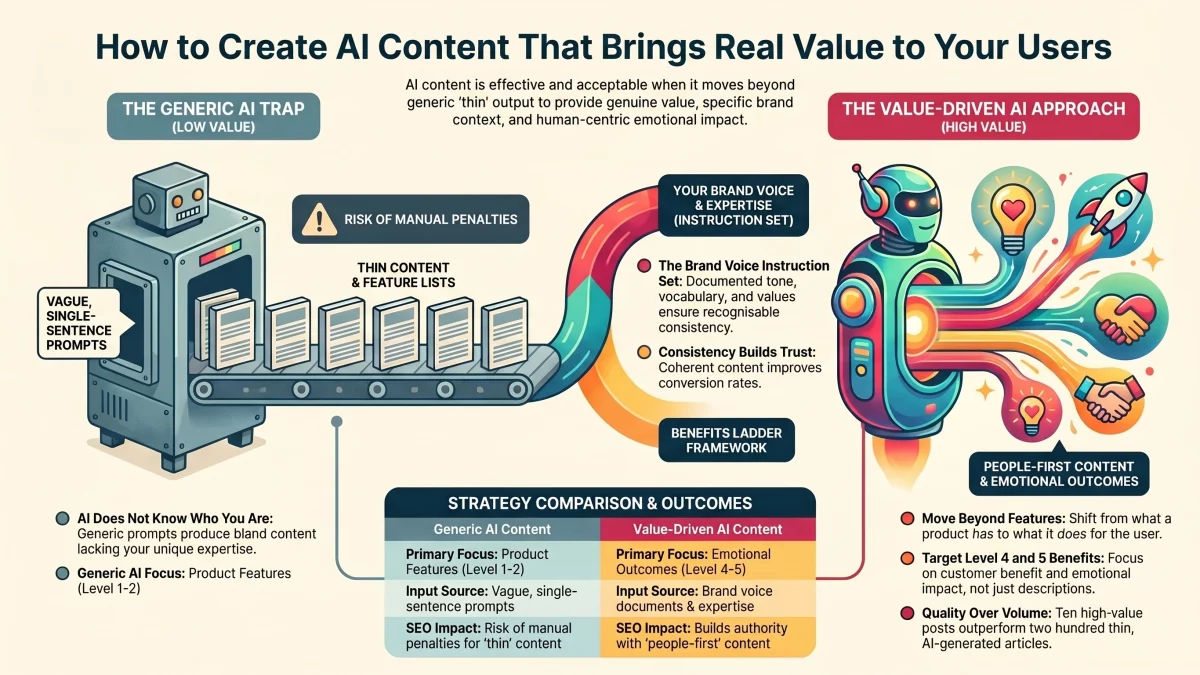
If you tried AI for content creation, got output that sounded like it was written by a bored robot, and went back to doing everything yourself, you are not alone. Most small business owners hit this wall. The problem is not the AI. The problem is what you fed it. Generic input produces generic output. Every time. This post gives you ten practical tips to create content that’s on-brand, builds trust with your audience, doesn’t send Google’s spam detectors into meltdown, and sounds like, dare I say it, human.
If you prefer, you can listen to an AI-generated podcast giving hot tips on how to make AI sound human;
Why AI Content Sounds Generic
The single biggest reason AI content creation fails is simple: the AI does not know who you are. You open ChatGPT, type a vague request, and get vague output. That is not a technology problem. That is an input problem.
Google has become increasingly strict about low-quality AI content. In 2024, a Google core update specifically targeted sites publishing high volumes of thin, unhelpful content. One site received a manual penalty after publishing 200 posts in a single month. The content was recognisably AI-generated, and it lacked any real value for readers.
The fix is not to avoid AI. The fix is to give it something substantial to work with. That means:
- A documented brand voice that captures your tone, language, and values.
- Strategic frameworks that shape what the content says, not just how it says it.
- Real business context, so the output reflects your expertise, not a generic version of your industry.
Get the input right, and the output follows.
What a Brand Voice Document Actually Does for AI Content Creation
A brand voice document is not a style guide collecting dust in a folder. It is the instruction set that turns a generic AI content tool into something that sounds like you wrote it.
Without one, every piece of content you generate starts from zero. The AI defaults to averaging across everything it has ever seen, which means bland, middle-of-the-road output that could belong to any business in your sector.
With a proper brand voice document, you capture:
- The specific words and phrases you use (and the ones you never use).
- Your tone across different contexts, such as social posts versus service pages.
- Your personality, your values, and the way you talk to customers.
According to the Content Marketing Institute, brands with a documented voice consistently produce more coherent and recognisable content. That consistency builds trust. And trust converts.
Think of your brand voice document as the single most valuable thing you can give an AI tool.
How the Benefits Ladder Stops Your Content Sounding Like a Features List
Most AI-generated content defaults to features. It tells readers what a product has, not what it does for them. That is why it fails to convert.
The Benefits Ladder changes that. It is a framework that moves content from product-level description up to genuine emotional benefit, the level that actually motivates people to act.
Here is how the levels work:
- Level 1 is the product itself, simply what it is.
- Level 2 is the feature, what the product has.
- Level 3 is the product benefit, what it does.
- Level 4 is the customer benefit, what it means for them.
- Level 5 is the emotional benefit, how it makes them feel.
Most AI content stops at Level 2 or 3. Commercial content needs to reach Level 4 or 5. When you give your AI tool the Benefits Ladder as a framework, you move from “includes three sessions” to “save eight hours a week on content, starting this week.” That is the difference between content that fills space and content that sells.
Ten Practical Tips to Get Better Results from AI Content Tools
Knowing the theory is one thing. Here are ten actionable tips you can apply right now:
- Write a brand voice document before you generate a single piece of content, because it sets the foundation that everything else depends on.
- List your banned words and phrases explicitly, so the AI never uses language that sounds off-brand.
- Always brief the AI with the Benefits Ladder in mind, leading with Level 4 or Level 5 outcomes.
- Give the AI real examples of content you have written, so it learns your rhythm and sentence structure.
- Specify your audience in every brief, because “small business owners who tried AI and gave up” produces better output than “business owners.”
- Set a realistic publishing pace rather than chasing volume, because ten quality posts outperform two hundred thin ones every time.
- Review every piece of AI output before publishing, treating it as a first draft rather than a finished article.
- Build your brief around a specific question your audience is actually asking, not a broad topic.
- Use your own expertise to add a unique insight or example in every post, because that is the layer AI cannot fabricate.
- Treat your AI system as something you build and refine over time, not a button you press once.
These are not complicated. They are consistent. And consistency is what separates content that builds authority from content that gets ignored.
What Makes AI Content Safe and Valuable for SEO in 2025
Google’s position on AI content is clear. The Search Central guidance states that what matters is whether content is helpful, reliable, and people-first, regardless of how it was produced. AI-generated content is not penalised by default. Lazy, thin, high-volume content is.
That distinction matters enormously for small business owners. You do not need to publish constantly to build SEO authority. You need to publish content that genuinely answers your audience’s questions better than anyone else.
Practical ways to keep your AI content safe and effective:
- Publish at a sustainable pace that allows proper review and editing of every post.
- Add original insight, data, or examples that cannot be found elsewhere.
- Ensure every post has a clear purpose and serves a specific audience need.
- Use structured frameworks like the Benefits Ladder to produce content with genuine substance.
- Keep your brand voice consistent across all content, which signals authorship and authenticity to both readers and search engines.
Quality over quantity is not just good advice. It is a survival strategy.
Frequently Asked Questions
How do I stop AI-generated content sounding generic?
The most effective way to stop AI content creation from sounding generic is to give the AI a detailed brand voice document before you write a single brief. This document captures your tone, your language preferences, your banned words, and the way you naturally talk to customers. Without it, the AI averages across everything it has ever seen, which produces bland, interchangeable output. With it, the AI has a specific personality to work from. Pair this with real examples of content you have written yourself, and the output becomes noticeably more distinctive from the first draft.
What is the Benefits Ladder, and why does it matter for AI content?
The Benefits Ladder is a framework that moves content up from basic product description to genuine emotional outcome. Most AI content creation tools default to writing about features and specifications, which is the bottom of the ladder. The Benefits Ladder pushes content to Level 4 (what the product means for the customer) and Level 5 (how it makes them feel). This matters because people do not buy features. They buy outcomes and feelings. When you give the AI this framework as part of your brief, the content becomes more persuasive and more aligned with what actually motivates your audience to act.
Why did Google penalise sites for publishing too much AI content?
Google did not penalise those sites simply for using AI. It penalised them for publishing large volumes of thin, unhelpful content that provided no real value to readers. One widely reported case involved a site publishing 200 posts in a month, all of which were recognisably low-quality and AI-generated. Google’s helpful content systems are designed to identify and demote exactly this kind of content. The lesson is not to avoid AI content creation. The lesson is to publish at a pace that allows genuine quality control, and to ensure every piece serves a real audience need.
Do I need a brand voice document if I am a one-person business?
Yes, especially if you are a one-person business. Your personality and voice are your biggest competitive advantage. A brand voice document captures that advantage and makes it replicable, whether you are using AI tools, briefing a freelancer, or writing content yourself after a long day. Without it, your content becomes inconsistent over time. With it, every piece of content reinforces who you are and builds recognition with your audience. The process of creating one also forces you to get clear on what you stand for, which improves every piece of content you produce, AI-assisted or not.
Can AI content creation actually save me time without hurting quality?
Yes, but only if your system is set up correctly. AI content creation can reduce the time you spend on content from two hours per post to twenty minutes, but that result depends entirely on the quality of your briefing, your brand voice document, and the frameworks you give the AI to work with. Without those foundations, you spend more time editing than you saved writing. With them, you get a strong first draft that needs light review rather than a complete rewrite. The time saving is real and measurable. It just requires a proper setup before it delivers consistent results.
If you are tired of content that sounds like it came from a template, and you want a system that produces output that genuinely sounds human, the AI Quick Start is where to start. Book AI Quick Start today and start publishing quality AI content that brings value to your audience.