
Building a brand voice strategy takes time you probably don’t have. You know your business, you know your values, and you’ve got a sense of how you want to sound. But turning that instinct into a documented, consistent brand voice across every piece of content? That’s where most small business owners stall. AI can help you get there faster, but only if you use it the right way. This post explains exactly how AI fits into your brand voice strategy, what it can and can’t do, and how a practitioner-led approach gets you results without the guesswork.
If you want, you can listen to a discussion on the blog topics here;
Why Most Small Businesses Don’t Have a Brand Voice Strategy Yet
The honest answer is that proper brand strategy has always felt like something reserved for businesses with a marketing director and a six-figure agency budget. You’re running operations, managing clients, and creating content yourself. A documented brand voice strategy sits permanently on the to-do list.
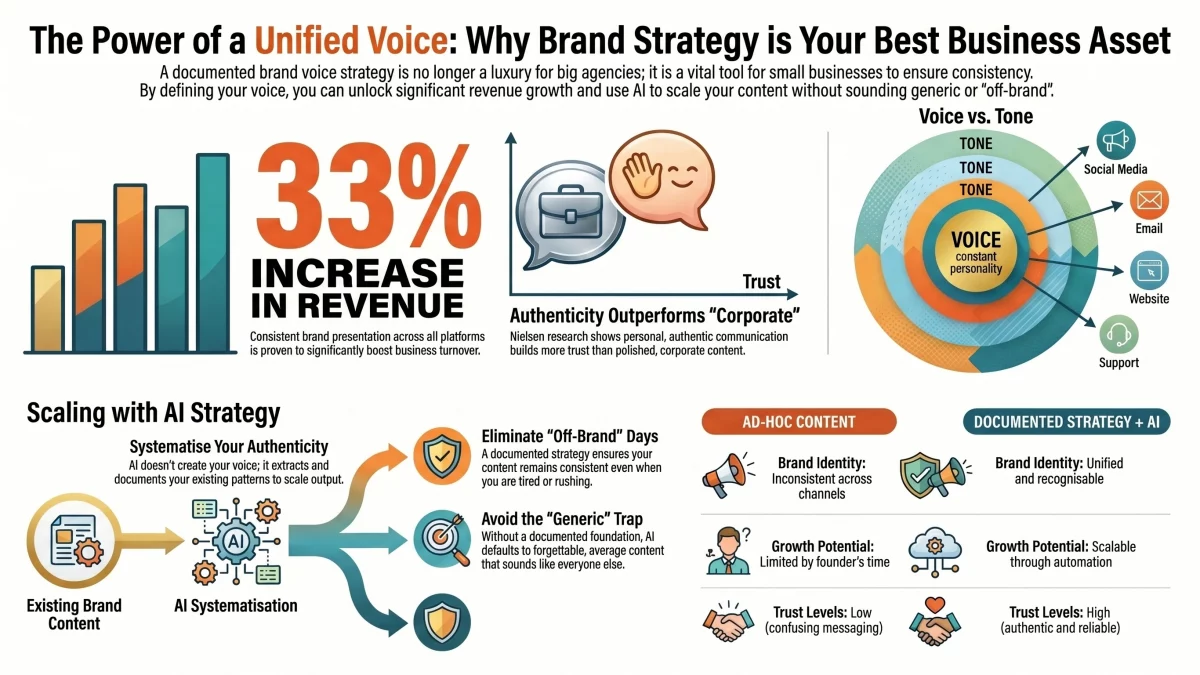
That’s a real business problem. Without a clear brand voice, your content sounds inconsistent. Your website says one thing, your social media says another, and your emails sound like a different business entirely. Research from Tailor Brands shows that consistent brand presentation increases revenue by up to 33%. That’s not a marginal gain. That’s the difference between a brand people remember and one they scroll past.
The good news is that AI has changed the access equation. You no longer need months of workshops and expensive consultants to get clarity on your brand voice. You need the right process and the right person to run it.
How AI Actually Supports Your Brand Voice Strategy
AI doesn’t create your brand voice. That’s the most important thing to understand before you go anywhere near a chatbot. Your brand voice comes from your values, your expertise, your customer relationships, and the way you naturally communicate. AI can’t invent that. What it can do is help you extract, document, and systematise it faster than any traditional process.
Here’s where AI genuinely adds value in brand strategy work:
- AI can analyse your existing content and identify the patterns in how you already communicate, giving you a baseline to build from.
- AI can help you stress-test your brand positioning by generating competitor comparisons and identifying the gaps where your voice can stand out.
- AI can translate your documented brand voice into consistent content across multiple formats, so your tone stays on-brand whether you’re writing a product page or a LinkedIn post.
- AI can flag when draft content drifts from your established voice, acting as a quality check on everything you or your team produces.
The critical word in all of this is “documented.” AI only works consistently when your brand voice is captured properly. Without that foundation, you get generic output.
What a Proper Brand Voice Strategy Actually Involves
A brand voice strategy isn’t a mood board and three adjectives. It’s a working document that shapes every piece of communication your business produces. The Content Marketing Institute defines brand voice as the distinct personality a brand takes on in its communications, but the definition is the easy part. Building it is where most businesses need help.
A proper brand voice strategy covers:
- A clear articulation of your brand values and how they translate into communication style, so every piece of content feels intentional rather than accidental.
- Your tone spectrum across different contexts, because the way you write a sales page is different from how you write a customer complaint response.
- Your language rules, including the words and phrases that are distinctly yours and the ones you’d never use, because consistency comes from specific decisions, not vague guidelines.
- Audience positioning that reflects not just who your customers are but how they want to be spoken to, which is often different from how businesses assume.
When AI is built into this process from the start, the resulting strategy is immediately usable, not just a document that lives in a folder.
How to Use AI Without Losing Your Authentic Voice
The biggest fear small business owners have about AI and brand voice is sounding like everyone else. It’s a legitimate concern. Generic AI output is everywhere, and it all sounds the same: polished, inoffensive, and completely forgettable.
The answer isn’t to avoid AI. The answer is to train it properly on your specific voice before you use it for anything. This is exactly what separates a brand-first AI approach from generic ChatGPT experimentation.
When AI is set up correctly, your authentic voice becomes more consistent, not less. You stop having off-brand days when you’re tired or rushed. Your team can produce content that sounds like you, even when you’re not involved. And you can scale your content output without the hours of effort that currently make it unsustainable.
Nielsen’s research on trust in advertising consistently shows that authentic, personal communication outperforms polished corporate content, particularly for small businesses where the founder’s voice is part of the product. Protecting that authenticity while using AI isn’t just possible. It’s the whole point.
What to Look for in a Brand Strategy Partner Who Understands AI
Not every brand strategist understands AI, and not every AI consultant understands brand strategy. For your brand voice strategy to work in practice, you need both. Here’s what separates a useful partner from one who delivers a presentation and disappears:
- They start with your brand, not with AI tools. The technology should serve your voice, not define it.
- They produce working outputs, not just frameworks. You should leave with a documented brand voice you can use immediately.
- They have direct experience creating content for real businesses, not just teaching theory about how it should work.
- They build your AI system around your documented voice, so you’re not starting from scratch every time you open a new chat window.
- They can show you results from businesses like yours, not just case studies from enterprise clients with different challenges.
The difference between a good brand strategy session and a bad one is whether you leave with clarity and a system that works, or a folder full of slides you never open again.
Frequently Asked Questions
How does AI help with brand voice strategy for a small business?
AI helps small businesses develop and document their brand voice faster than traditional methods. In practice, this means AI can analyse your existing content to identify your natural communication patterns, help you articulate your positioning clearly, and then be trained to replicate your voice consistently across all your content. The key is that your brand voice strategy has to be documented first. AI doesn’t create your voice from nothing. It amplifies and systematises what already exists in your business. For small business owners creating content themselves, this means your brand sounds consistent whether you’re writing at full energy or at the end of a long week.
What is the difference between brand voice and brand tone?
Brand voice is the consistent personality your business communicates with; it stays the same across everything you produce. Brand tone is how that voice adapts to different situations. Your brand voice might be direct, warm, and plain-speaking. Your tone will shift slightly depending on context: a complaint response needs more care and formality than an Instagram caption, but both should still sound like the same business. A good brand voice strategy documents both. It defines your core voice clearly and gives you guidelines for how tone adjusts across different content types, so your team can make the right call in any situation without asking you every time.
Why does my brand voice strategy need to be documented before I use AI?
Without documentation, AI produces generic content. It has no reference point for what makes your voice yours, so it defaults to the average of everything it has been trained on. That’s why so much AI content sounds the same. When your brand voice strategy is properly documented, with your values, language rules, tone guidelines, and positioning captured in detail, AI can use that as a foundation. Every piece of content it produces is built on your specific voice rather than a generic template. Documentation also means your team, a freelancer, or a new hire can produce on-brand content without needing you in the room.
Do I need a big budget to get a proper brand voice strategy with AI?
You don’t need an enterprise budget, but you do need to invest properly. The businesses that get real results from brand voice strategy are the ones that treat it as a business asset rather than a marketing expense. A done-with-you brand strategy session that builds your AI system at the same time is a very different investment from a traditional agency retainer that produces a brand document and then charges you monthly to use it. The right approach gives you a working system you own, so the value compounds over time. Every piece of content you produce from that point uses your documented brand voice strategy, without ongoing agency fees.
Can AI replace a brand strategist when developing my brand voice?
AI can support brand strategy work, but it can’t replace the thinking that makes a brand voice strategy useful. Brand strategy requires understanding your market position, your customer psychology, the gaps your competitors are leaving, and the specific language choices that will make your voice distinctive. AI doesn’t have that business context unless a skilled practitioner provides it. What AI does well is helping you stress-test ideas quickly, identify patterns in your existing communication, and systematise the voice once it’s been properly defined. The combination of experienced brand strategy thinking and AI implementation is where you get results. Either one alone is less effective.
If you’re ready to stop guessing and start building a brand voice strategy that actually scales with your business, the Brand Strategy + AI service gives you a documented voice, a working AI system, and the strategic frameworks to use both confidently. Book a brand voice consultation and determine your brand strategy with AI.