
If you’re a tradesperson trying to win more work locally, you already know Google matters. What you might not know is why your competitors keep showing up, and you don’t. This post is for self-employed tradespeople and small trades businesses who want more enquiries from local search. You’ll learn what SEO services for local businesses actually include, what makes the difference on Google Maps, and what to look for so you stop wasting money on things that don’t move the needle.
Discover how to hit the Map Pack;
Why Local Tradespeople Struggle to Show Up on Google Maps
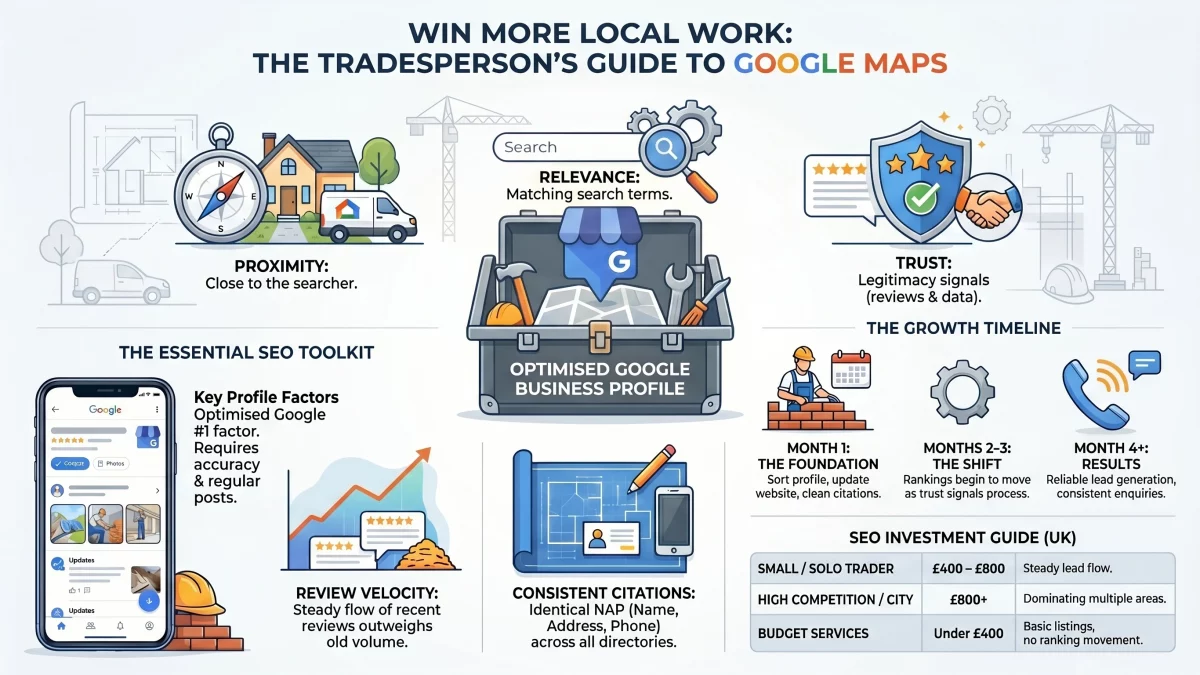
Most tradespeople don’t have a visibility problem. They have a reputation and relevance problem. Google Maps ranks businesses based on three things: proximity to the searcher, relevance to the search term, and how much it trusts your business. If your Google Business Profile is thin, your reviews are sparse, or your website doesn’t clearly say what you do and where you do it, Google won’t show you. Your competitors aren’t necessarily better at the job. They’ve just given Google more reasons to trust them. The good news is that trust is buildable. Local SEO services for local businesses exist to close exactly that gap, systematically and without shortcuts that get you penalised six months later.
What Good SEO Services for Local Businesses Actually Include
Too many tradespeople get sold “SEO” and receive a monthly PDF with traffic numbers that mean nothing to them. Good local SEO is specific. It works on the signals Google uses to decide who to show when someone searches “plumber near me” or “roofer in Leeds.” Here’s what a proper service should cover:
- Your Google Business Profile needs to be fully optimised with accurate categories, services, photos, and regular posting so Google treats it as an active, trusted listing.
- On-page website content needs to clearly match local search terms, with location pages or service area content that signals exactly where you operate.
- Review generation needs a repeatable system, because a steady flow of new reviews carries far more weight than 40 reviews from two years ago.
- Local citations (your business name, address, and phone number listed consistently across directories) build the foundational trust signals Google relies on.
- Monthly reporting should show rankings, calls, and direction requests, not just abstract traffic metrics.
How Long Does Local SEO Take to Get Results for a Trade Business?
This is the question most people ask and most agencies dodge. The honest answer is three to six months for meaningful movement, depending on how competitive your area is and how little work has been done before. A plumber in a rural town with no existing SEO competition might see results in six to eight weeks. A roofer in Manchester competing against established businesses with hundreds of reviews will take longer. What you should expect in the first month is a fully built foundation: your Google Business Profile sorted, your website content updated, your citations cleaned up. Months two and three is when rankings start to shift. Month four onwards is where enquiries reliably increase. Anyone promising page one in two weeks is selling you something that won’t last.
Do You Need a Website to Benefit From Local SEO Services?
You don’t need a website to appear on Google Maps, but you’re leaving a significant amount of work on the table without one. Your Google Business Profile can rank in the local pack (the map results) on its own, especially in less competitive areas. But a website gives Google more content to assess your relevance, lets you rank in organic results below the map, and gives potential customers somewhere to read about you, see your work, and contact you directly. If your website is old, slow, or doesn’t mention your service areas clearly, it can actually hold your local rankings back rather than help them. A basic but well-structured trade website, paired with a properly maintained Google Business Profile, is the combination that consistently produces results.
What Makes Local SEO Different From General SEO Services?
General SEO focuses on ranking for broad search terms at national or global scale. Local SEO is narrower, more targeted, and for most tradespeople, far more valuable. Someone searching “emergency electrician Bristol” is ready to hire. That’s the intent local SEO captures. The tactics are also different. General SEO leans heavily on content volume and backlink building. Local SEO focuses on Google Business Profile management, location-relevant content, review velocity, and local citation consistency. For a tradesperson, showing up in the top three map results for your core service and location is worth more than any amount of blog traffic. SEO services for local businesses should be built around that goal specifically, not adapted from a strategy designed for national e-commerce brands.
Frequently Asked Questions
How much should a tradesperson pay for local SEO services?
Pricing for local SEO varies, but for a self-employed tradesperson or small trades business, you should expect to pay between £400 and £800 per month for a service that actually moves the needle. Below that, you’re likely getting a basic directory submission service dressed up as SEO. Above £800 per month can make sense if you’re operating in a highly competitive city or want to dominate multiple service areas. The key question isn’t what you pay, it’s what you get. A good local SEO service should include Google Business Profile management, website content updates, review support, and clear monthly reporting showing calls and ranking movement.
What is the most important factor for local search rankings?
Your Google Business Profile is the single most important factor for appearing in Google Maps results. It needs to be fully completed with the right business categories, accurate service areas, regular photo uploads, and consistent posting activity. But it doesn’t work in isolation. The number and recency of your reviews, the consistency of your business details across the web, and the relevance of your website content all feed into your ranking. Think of it as a trust score. Google is deciding whether to recommend your business to someone in your area. Every signal you give it builds or undermines that trust.
Why are my competitors showing up on Google Maps and I’m not?
There are usually three reasons. First, their Google Business Profile is more complete and more active than yours. Second, they have more recent reviews, which signals to Google that they’re a live, trusted business. Third, their website content more clearly matches what people search for in your area. SEO services for local businesses are designed to close each of those gaps in a structured way. It’s rarely one big fix. It’s a series of smaller improvements that compound over time. The businesses that dominate local search didn’t get there overnight, but they also didn’t do anything mysterious. They just did the basics properly and kept at it.
Do reviews actually affect local search rankings?
Yes, significantly. Google uses reviews as a trust and relevance signal. Businesses with a higher number of recent reviews consistently outrank those with fewer, even when other factors are similar. It’s not just the star rating that matters. The frequency of new reviews, whether you respond to them, and whether reviewers mention your services or location in their text all contribute. A tradesperson with 15 reviews from the last three months will often outrank one with 60 reviews from three years ago. Building a simple, repeatable process to ask happy customers for a review is one of the highest-return activities in local SEO.
Can I do local SEO myself or do I need a professional service?
You can handle some of it yourself, particularly keeping your Google Business Profile updated, asking for reviews, and making sure your business details are consistent across the web. These things take time, but not specialist knowledge. Where professional SEO services for local businesses add the most value is in the technical side of your website, identifying which search terms are worth targeting in your specific area, and building the kind of consistent monthly activity that compounds over time. Most tradespeople try it themselves, get inconsistent results, and then bring in a specialist. There’s no shame in that, but it often means six months of slower progress than necessary.
If you’re ready to stop watching competitors take the calls that should be coming to you, a structured approach to local SEO makes the difference. Find out exactly what local SEO can do for your trade business. Book a free call today.