
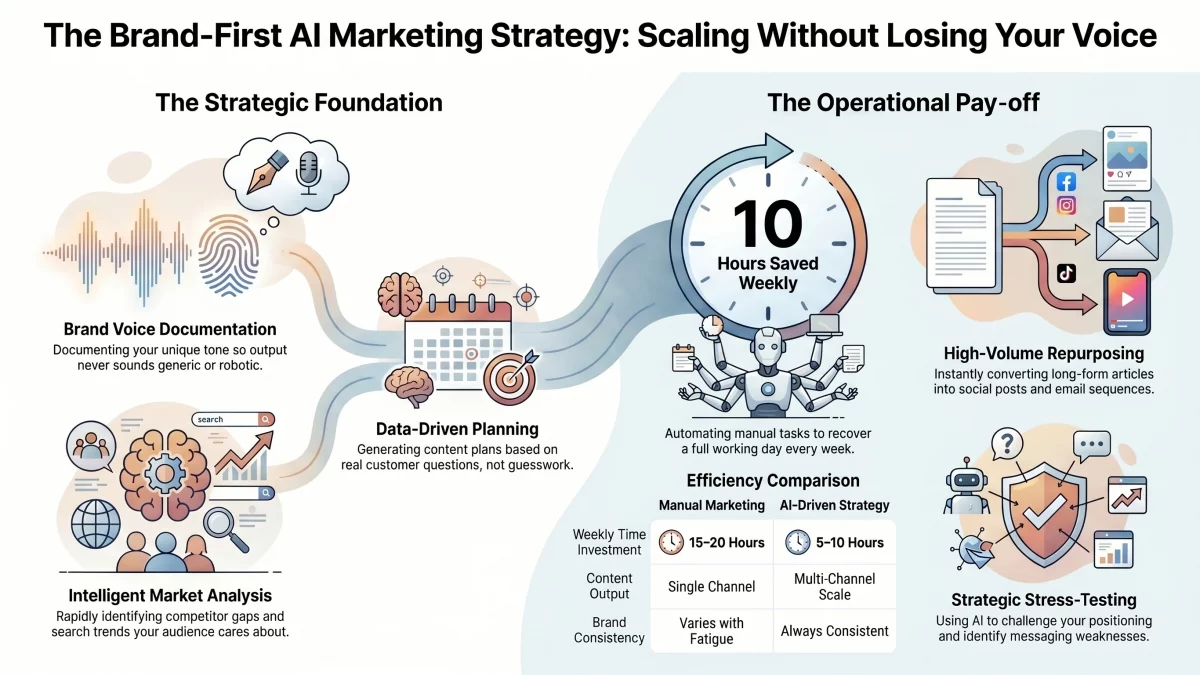
Most small business owners know they need to be producing more content, more consistently, across more channels. The problem is that marketing alone can eat 15-20 hours of your week, and that is before you actually run the business. An AI marketing strategy is not about replacing your judgment or your voice. It is about giving you the tools to work faster, think sharper, and create better content without burning out. This post breaks down exactly how AI can help you at every stage of your marketing, from analysing data to writing content that actually converts.
Get a great AI-generated overview of this post;
What Does an AI Marketing Strategy Actually Do for a Small Business?
The biggest misconception about AI in marketing is that it is just a writing tool. It is not. A proper AI marketing strategy covers the full picture: research, planning, content creation, and performance analysis. AI handles the time-consuming work so you can focus on the decisions that actually require your expertise.
Here is what a well-built AI marketing strategy does for you:
- It analyses your market and competitor positioning faster than any manual research, giving you a clear picture of where opportunities exist.
- It helps you plan content that answers the questions your customers are already searching for, rather than guessing what might land.
- It drafts, refines, and repurposes content across multiple formats, cutting production time from hours to minutes.
- It surfaces patterns in your data that tell you what is working and what is wasting your time and budget.
The result is a marketing operation that punches well above your weight, without hiring a full team.
How Can AI Help with Marketing Data Analysis?
Data is only useful if you can actually read it and act on it quickly. For most small business owners, analytics dashboards are either ignored or overwhelming. AI changes that.
When you feed your performance data into an AI system, you get clear, plain-English summaries of what is happening. You can ask it to compare this month’s content performance against last month, identify which topics are driving traffic, or flag where customers are dropping off in your funnel. You get answers in seconds rather than spending an afternoon in spreadsheets.
Beyond your own data, AI is exceptionally good at analysing:
- Search trends that show you what your target customers are actively looking for right now.
- Competitor content gaps, revealing topics your rivals are missing that you can own.
- Customer feedback patterns that reveal the exact language your audience uses to describe their problems.
This level of insight used to require a dedicated analyst. Now it takes a well-structured prompt and ten minutes.
How Does AI Support Content Creation Without Sounding Generic?
This is the fear that stops most small business owners from committing to AI: what if everything ends up sounding the same as everyone else? It is a legitimate concern, but it is a problem with how people use AI, not with AI itself.
When your brand voice is properly documented and built into your AI system, the output reflects your personality, your perspective, and your way of speaking to customers. Generic output happens when people treat AI as a shortcut rather than a system.
A brand-first AI marketing strategy gives you content that sounds like you because it was trained on you. That means:
- Blog posts that carry your actual opinions and expertise, not just a recycled summary of what everyone else is saying.
- Social media content that fits your tone, whether that is authoritative, conversational, or direct.
- Email copy that your subscribers recognise as yours before they even see your name at the top.
The volume goes up. The quality stays consistent. The voice remains yours.
What Marketing Strategy Tasks Can AI Handle That Would Otherwise Take Hours?
The time savings are where business owners feel AI most immediately. Tasks that previously took half a day can be completed before your morning coffee goes cold.
A solid AI marketing strategy handles the heavy lifting across your entire content operation:
- Keyword and topic research, including finding the questions your ideal customers are actively searching so your content gets found.
- First drafts of blog posts, landing pages, product descriptions, and email sequences, ready for your review and personal touches.
- Repurposing long-form content into social posts, short videos scripts, or newsletter sections, multiplying your output without multiplying your effort.
- Reviewing existing content and suggesting improvements based on clarity, persuasion, and SEO best practice.
Most small business owners who implement a proper AI marketing strategy recover 8-10 hours every single week. That is a working day returned to you every week.
How Does AI Improve Your Overall Marketing Strategy and Decision-Making?
Beyond individual tasks, AI makes you a sharper strategic thinker. It gives you a sounding board that never runs out of energy, never bills by the hour, and draws on an enormous base of marketing knowledge.
You can use AI to stress-test your positioning. Ask it to argue against your current approach, identify weaknesses in your messaging, or map out how your ideal customer would respond to a new campaign idea. It will give you honest, structured feedback that most business owners simply do not have access to without hiring an expensive consultant.
Over time, your AI marketing strategy compounds. Every piece of content you create further trains your system. Every data insight sharpens your targeting. Every customer interaction you feed back in makes your next piece of content more accurate. It is a system that gets better the more you use it, built around the thing that makes your business distinctive: your voice and your expertise.
Frequently Asked Questions
How do I start building an AI marketing strategy for my small business?
The best place to start is with your brand voice, not the technology. Before you touch any AI tool, you need a clear record of how you speak, what you stand for, and what your customers actually care about. Once that is documented, you build your AI system around it. From there, you identify the marketing tasks eating most of your time and start replacing them with AI-assisted processes. Most small business owners who approach it this way see meaningful time savings within the first week. A structured two-hour session with someone who knows how to set this up properly will save you months of trial and error.
What are the real benefits of using an AI marketing strategy compared to doing everything manually?
The most immediate benefit is time. Small business owners typically spend 15-20 hours a week on content and marketing tasks. A proper AI marketing strategy cuts that by 50-70%, without any reduction in quality. Beyond time, you get consistency: your content sounds the same whether you wrote it on a Tuesday morning full of energy or a Thursday afternoon when you are exhausted. You also get scale. AI lets you produce content across more channels, more regularly, than any solo business owner could manage alone. These benefits compound over time as your system learns more about your business and your audience.
Why does AI-generated content sometimes sound generic, and how do I avoid it?
Generic AI output is almost always the result of a generic input. If you give AI no context about your brand, your customers, or your perspective, it falls back on averaging everything it has ever learned. That is where the lifeless, robotic content comes from. The solution is to build your AI system on a detailed brand voice document that captures your tone, your values, your customer language, and your specific expertise. When AI has that foundation, it produces content that reflects your business accurately. This is the difference between treating AI as a shortcut and using it as a proper content system.
Do I need technical skills to implement an AI marketing strategy?
No. The tools themselves, primarily platforms like ChatGPT or Claude, are designed for normal conversation. You do not need to write code or understand machine learning. What you do need is a clear process for setting up your AI system correctly from the start, which includes documenting your brand voice and building the right structure so the AI has everything it needs to produce useful output. Most small business owners find that once someone shows them how to set it up properly, it becomes a natural part of their daily routine within a few days.
Can an AI marketing strategy help with SEO and getting found online?
Yes, and this is one of the areas where AI delivers some of its strongest results. AI is exceptionally fast at identifying the search terms your ideal customers use, finding gaps in the content your competitors are publishing, and structuring your content so it answers search queries clearly and completely. A well-executed AI marketing strategy does not just help you create more content. It helps you create the right content, targeting the right searches, with the right structure to rank. For small businesses competing against larger players with bigger budgets, this kind of targeted, consistent SEO content is one of the most effective tools available.
An AI marketing strategy is the most practical way for a small business owner to compete at scale without burning out or blowing the budget. If you are ready to stop spending your week on content that takes forever and start building a system that works while you run your business, Book your AI Quick Start session and discover your full marketing team that you don’t have to pay for.