
You’ve paid an SEO agency, watched your rankings inch upward, and waited for the phone to ring. It didn’t. That’s not bad luck. That’s a fundamental mismatch between what most SEO services for local businesses actually deliver and what your business genuinely needs.
The Real Goal of Local SEO Isn’t Rankings
Rankings are a means to an end. The end is customers. It sounds obvious, but most SEO agencies report on keyword positions, domain authority scores, and backlink counts because those numbers are easy to show on a monthly report. They’re not easy to connect to your revenue.
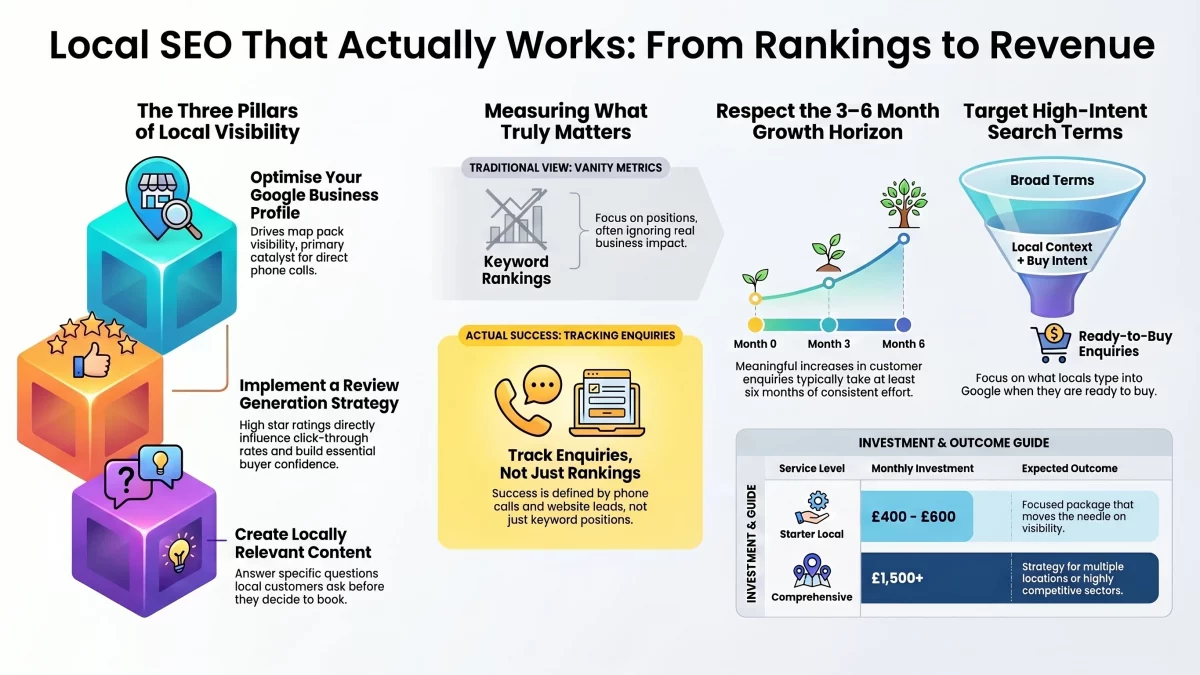
Effective seo services for local businesses work backwards from one question: what does someone in your area type into Google when they’re ready to buy? Then they make sure your business shows up, looks trustworthy, and gives that person a reason to contact you rather than the next result down the page. Everything else, the technical audits, the content, the citations, serves that single outcome.
If your SEO agency can’t explain how each activity connects to enquiries, that’s a problem.
If you prefer, you can listen to this post on this AI-generated podcast;
Why Most Local SEO Efforts Fail to Generate Enquiries
The gap between ranking and converting is where money gets wasted. A business can rank on page one for a keyword that nobody with buying intent actually searches. Or it can rank well but have a Google Business Profile that looks incomplete, a website that loads slowly on mobile, or no reviews to give visitors confidence.
Local search in 2026 is more competitive than it was three years ago. AI-generated results, map pack listings, and local service ads all compete for the same screen space. Getting noticed requires more than a few optimised pages. It requires a joined-up approach: your Google Business Profile, your website, your reviews, and your local content all working together to show Google and your potential customers that you’re the obvious choice in your area.
What Good SEO Services for Local Businesses Actually Include
Good local SEO starts with your Google Business Profile, because that’s what drives map pack visibility, and map pack visibility drives calls. It includes consistent name, address, and phone number data across directories. It includes a review generation strategy because star ratings directly influence click-through rates. And it includes locally relevant content that answers the questions your customers are actually asking before they contact anyone.
It also includes honest reporting. Not a spreadsheet of rankings, but a clear picture of how many people found your business through search, how many clicked through to your website or called directly from Google, and whether those numbers are moving in the right direction month on month.
How to Judge Whether an SEO Agency Is Worth the Money
Ask one question before you sign anything: What does success look like in six months, and how will we measure it? If the answer focuses on ranking positions rather than traffic, calls, or enquiries, walk away.
Good agencies set realistic expectations. Local SEO typically takes three to six months to produce meaningful results. Anyone promising page one rankings in thirty days is either targeting keywords nobody searches or telling you what you want to hear. Look for an agency that talks about your customers before they talk about your competitors. Look for one that asks about your business, your margins, your busiest months, and which services you most want to grow. That context is what separates strategy from activity.
The Compounding Value of Getting Local SEO Right
One of the underappreciated aspects of local SEO is that it compounds. A well-optimised Google Business Profile with strong reviews and consistent local content keeps working for you month after month. Unlike paid advertising, where visibility stops the moment you stop paying, organic local search builds an asset.
Small businesses in competitive local markets who invest consistently in SEO services see returns that paid ads rarely match over a twelve-month horizon. That doesn’t mean SEO replaces ads. It means the two work very differently, and understanding that difference helps you allocate your marketing budget far more effectively. The businesses that win local search in 2026 aren’t spending the most. They’re spending consistently, on the right things, with clear visibility into what’s working.
Frequently Asked Questions
How long does it take for local SEO to start working?
Most local businesses start seeing measurable improvements in visibility within three to four months, though meaningful increases in enquiries often take closer to six months. The timeline depends on how competitive your market is, the current state of your Google Business Profile and website, and how consistently the work is done. Agencies that promise faster results are usually targeting low-volume keywords with little commercial value. Patience matters here, but so does seeing clear evidence of progress at each stage.
How much should I pay for SEO services for local businesses?
Credible SEO services for local businesses typically start at around £400 to £600 per month for a focused local package. Below that, you’re likely paying for activity that won’t move the needle. Above £1,500 per month, you should expect a more comprehensive strategy covering multiple locations or more competitive sectors. The question isn’t just what you pay. It’s what the agency is accountable for delivering. Make sure your contract specifies measurable outcomes, not just hours or tasks completed.
What’s the difference between local SEO and regular SEO?
Regular SEO aims to rank a website for broad search terms, often competing nationally or globally. Local SEO focuses specifically on making your business visible to people searching in your geographic area, including map pack results, Google Business Profile visibility, and locally targeted content. For most small businesses with a physical location or a defined service area, local SEO delivers far more practical value than broad SEO. It connects you with people who are close by and ready to buy.
Do I need a new website for local SEO to work?
Not necessarily. Many local SEO improvements happen at the Google Business Profile level and in how your existing website handles local content. That said, if your website is slow, hard to navigate on mobile, or doesn’t clearly communicate what you do and where you do it, that will limit how much SEO can achieve. A technical audit early on will tell you whether your site is helping or hindering. In most cases, targeted improvements to existing pages are more cost-effective than a full rebuild.
Why did my rankings improve, but my enquiries didn’t change?
This is one of the most common frustrations with SEO services for local businesses, and it usually comes down to one of three things. First, the keywords you ranked for didn’t match what your actual buyers search. Second, your listing or website didn’t give visitors enough confidence to contact you, perhaps missing reviews, clear contact details, or a specific call to action. Third, the traffic increase was too small to translate into meaningful enquiries. Rankings are only part of the picture. What happens after the click matters just as much.
Can I do local SEO myself, or do I need an agency?
You can absolutely handle some of it yourself, particularly keeping your Google Business Profile updated, responding to reviews, and posting locally relevant content. Where most business owners run into trouble is with the more technical aspects and knowing what to prioritise.
Time is usually the bigger constraint. If you’re spending fifteen hours a week running your business, adding a structured SEO process on top is genuinely difficult. A good agency handles the complexity and frees you to focus on the work that actually needs you.
If you’re ready to stop guessing and start getting real results from local search, our Local SEO Starter package at £500 per month is built for exactly that situation. Ready to turn local search into real customers? Let’s talk.