If you prefer, you can listen to this NotebookLM generated podcast. It’s pretty much on the money in my opinion.
If you’ve been focused on SEO for the last decade, you already understand the value of being found. You’ve built backlinks, optimised your pages, and worked hard to climb the search rankings.
But something significant is shifting in how people find businesses online. And if you’re only playing by the old rules, you’re already losing ground in a game you might not even know you’re playing.
Welcome to the citation economy.
What Is the AI Citation Economy?
The AI citation economy is the new visibility landscape created by AI-powered search.
When someone types a question into ChatGPT, Perplexity, Google’s AI Overview, or any other AI answer engine, they don’t get a list of ten blue links. They get a direct answer — and that answer is built from sources the AI trusts enough to reference, or cite.
Those citations are the new currency of online visibility.
A citation happens when an AI system pulls information from your website, your content, or your brand presence and uses it to answer a user’s question — usually with a reference back to you. In practice, it looks like this: someone asks “what’s the best way for a small business to use AI for content marketing?” and the AI answer includes a reference to your blog post, your service page, or your expert commentary.
That’s a citation. And right now, most small businesses aren’t getting them.
Why the Citation Economy Matters for Your Business
Google’s AI Overviews now appear on a significant proportion of searches. ChatGPT has over 300 million weekly active users. Perplexity is growing fast as a research tool for business owners, marketers, and consumers.
These tools are answering questions that used to send traffic directly to your website. If your business isn’t being cited as a source, you’re invisible in those answers — and your competitors who are cited become the default recommendation.
The AI citation economy matters because visibility in AI search doesn’t come from domain authority or keyword density alone. It comes from being a trusted, citable source that AI systems recognise as authoritative, relevant, and well-structured.
If you’re not in the conversation, someone else is.
AI Citations vs. SEO Link Building: What’s the Difference?
This is where a lot of businesses get confused, so let’s get into it.
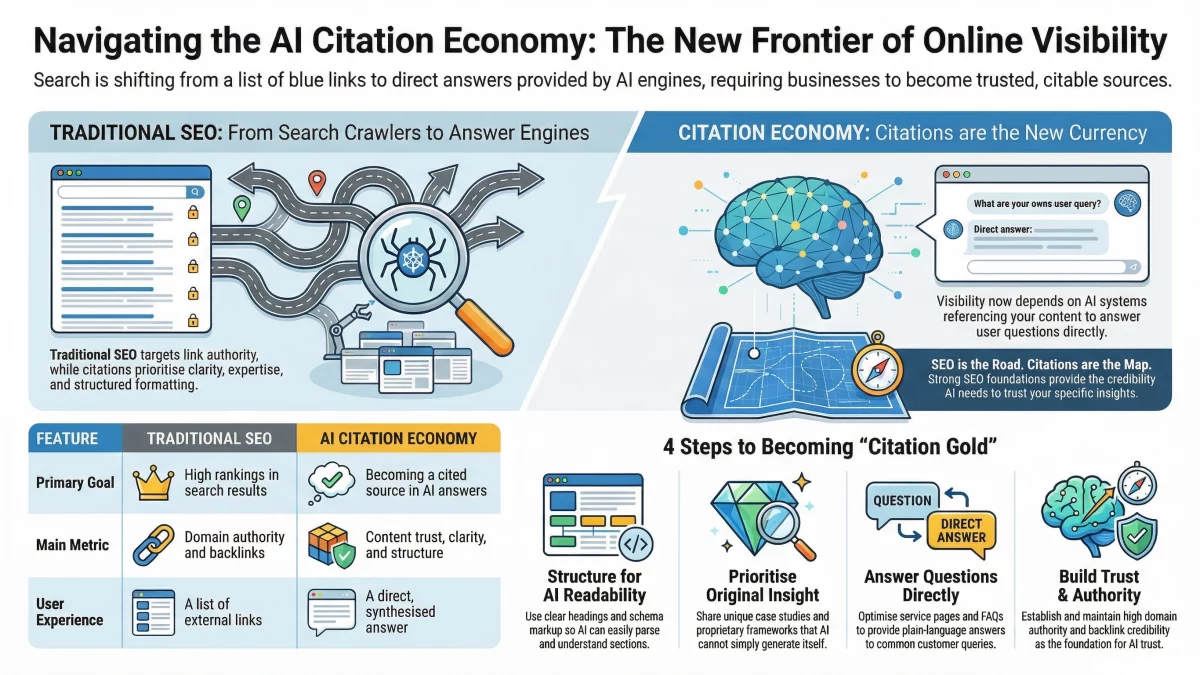
Traditional SEO link building is about earning hyperlinks from other websites pointing to yours. The more authoritative those sites, the more Google’s algorithm trusts your domain and rewards you with higher rankings. It’s a signal system built for search crawlers.
Citations in the AI search context work differently. They’re about whether AI systems trust your content enough to reference it when answering questions. That trust comes from several factors: clarity of information, depth of expertise, structured formatting that AI can easily parse, consistency of your brand voice across the web, and the quality of the content itself.
You can have excellent domain authority and still not get cited. You can also earn citations without having thousands of backlinks — particularly if your content is genuinely useful, well-organised, and answers specific questions clearly.
The mechanisms are different. The goal, however, is the same: get found by the people looking for what you offer.
The Sweet Spot: Where Link Building and Citations Meet
Here’s the good news. You don’t have to choose between traditional SEO and citation-building. The two approaches are more complementary than they are at odds.
Strong domain authority still matters. Google’s AI Overview pulls heavily from pages that already rank well. High-quality backlinks build the domain credibility that AI systems partially rely on when assessing source trustworthiness. So everything you’ve done in traditional SEO isn’t wasted — it’s a foundation.
What needs to change is the type of content you create on top of that foundation.
Citation-worthy content tends to:
• Answer specific, commonly-asked questions in clear, direct language
• Be structured with clear headings so AI can parse sections accurately
• Demonstrate genuine expertise rather than surface-level coverage
• Include original insight, data, or perspective that AI can’t simply generate itself
• Be consistent with your overall brand authority and positioning
Think of traditional SEO as building the road, and AI citations as making sure your business is on the map that people actually use to navigate it.
The sweet spot is content that ranks and gets cited. That means combining solid technical SEO foundations with content that AI systems recognise as genuinely useful and trustworthy.
How to Start Earning Citations
Getting cited by AI systems isn’t a mystery, but it does require deliberate effort. Here’s where to focus.
Build content that directly answers questions. AI systems are question-answering machines. If your content answers specific questions your ideal customers are asking — clearly, authoritatively, and in plain language — you become a natural source for those answers. FAQ sections on service pages, detailed how-to posts, and expert commentary on industry topics all perform well here.
Structure your content for AI readability. Use clear headings that describe exactly what each section covers. Break complex topics into digestible sections. Use schema markup on your website so AI crawlers can understand what your pages are about and who your business is. This is the technical side of citation-building, and it’s often overlooked.
Establish consistent brand authority across the web. Citations don’t just come from your website. They come from mentions of your business, your founder’s name, and your expertise across the wider web — in articles, interviews, directories, social profiles, and industry publications. AI systems build a picture of your authority from all of these sources combined.
Create genuinely original content. AI can already generate generic information on most topics. What it can’t generate is your specific experience, your case studies, your proprietary frameworks, and your unique point of view. Original insight is citation gold. Share what you actually know from doing the work, not just what the internet already says.
Optimise existing pages for AI answer engines. Review your key service and content pages. Ask yourself: if an AI system was trying to answer a question related to this page, could it clearly extract a useful answer? If the answer is buried in paragraphs of dense text, restructure it. If the page doesn’t have schema markup, add it. If the meta description doesn’t clearly state what the page is about, rewrite it.
The Most Common AI Citation Mistake: Doing Nothing
The biggest risk to your visibility in the citation economy isn’t using the wrong tactics. It’s waiting.
Many business owners are aware that AI search is changing things but are taking a “wait and see” approach. The challenge with that strategy is that citation authority takes time to build — just like traditional SEO did. The businesses that start now will have a head start that becomes increasingly difficult to close.
Every month that passes without citation-worthy content is a month your competitors have the opportunity to become the default reference point in your industry.
The businesses that thrive in the next phase of search will be the ones who understood early that visibility requires both traditional SEO and AI citation strategy — not one or the other.
Is Your Business Ready?
The citation economy is already here. The question isn’t whether it will affect your business. It’s whether you’re positioned to benefit from it or lose ground to competitors who are.
The good news: if you’ve invested in good SEO foundations, you’re not starting from scratch. You’re building on them.
The honest reality: most small business websites weren’t built with AI citation in mind. That means there are gaps — in content structure, schema markup, authority signals, and the type of content being created.
A content and visibility audit can show you exactly where those gaps are and what to prioritise first.
Find out where your business stands — book a Content & Visibility Audit with Power Copy.
The citation economy is the new visibility landscape created by AI-powered search. When someone uses an AI answer engine like ChatGPT, Perplexity, or Google’s AI Overview, they receive a direct answer built from sources the AI trusts enough to reference. Those citations — references back to your business, content, or expertise — are the new currency of online visibility.
Why do AI citations matter for small businesses?
AI search tools are answering questions that used to send traffic directly to your website. If your business isn’t being cited as a source in those answers, you’re invisible — and competitors who are cited become the default recommendation. Visibility in AI search doesn’t come from domain authority alone. It comes from being a trusted, citable source that AI systems recognise as authoritative, relevant, and well-structured.
What is the difference between AI citations and SEO link building?
Traditional SEO link building earns hyperlinks from other websites to boost your domain authority with search engine algorithms. AI citations work differently — they depend on whether AI systems trust your content enough to reference it when answering questions. That trust comes from content clarity, depth of expertise, structured formatting, brand consistency, and genuine usefulness. You can have strong domain authority and still not get cited, or earn citations without thousands of backlinks.
Do I need to choose between traditional SEO and AI citation building?
No. The two approaches are complementary. Strong domain authority still matters — Google’s AI Overview pulls heavily from pages that already rank well. What needs to change is the type of content you create. Citation-worthy content answers specific questions clearly, uses structured headings, demonstrates genuine expertise, and includes original insight that AI can’t simply generate itself.
How do I get my business cited by AI search engines?
Focus on five areas: create content that directly answers questions your ideal customers ask; structure content with clear headings and schema markup so AI can parse it accurately; build consistent brand authority across the web through articles, interviews, and directories; share genuinely original insight from your real experience; and review existing pages to ensure AI can easily extract a useful answer from them.
What happens if I ignore AI citation strategy?
Citation authority takes time to build, just like traditional SEO. Businesses that delay give competitors the opportunity to become the default reference point in their industry. Every month without citation-worthy content is a month your competitors can use to establish authority that becomes increasingly difficult to close.